

The Government of Canada’s economic overview shows that in many ways, the Canadian economy is doing well.
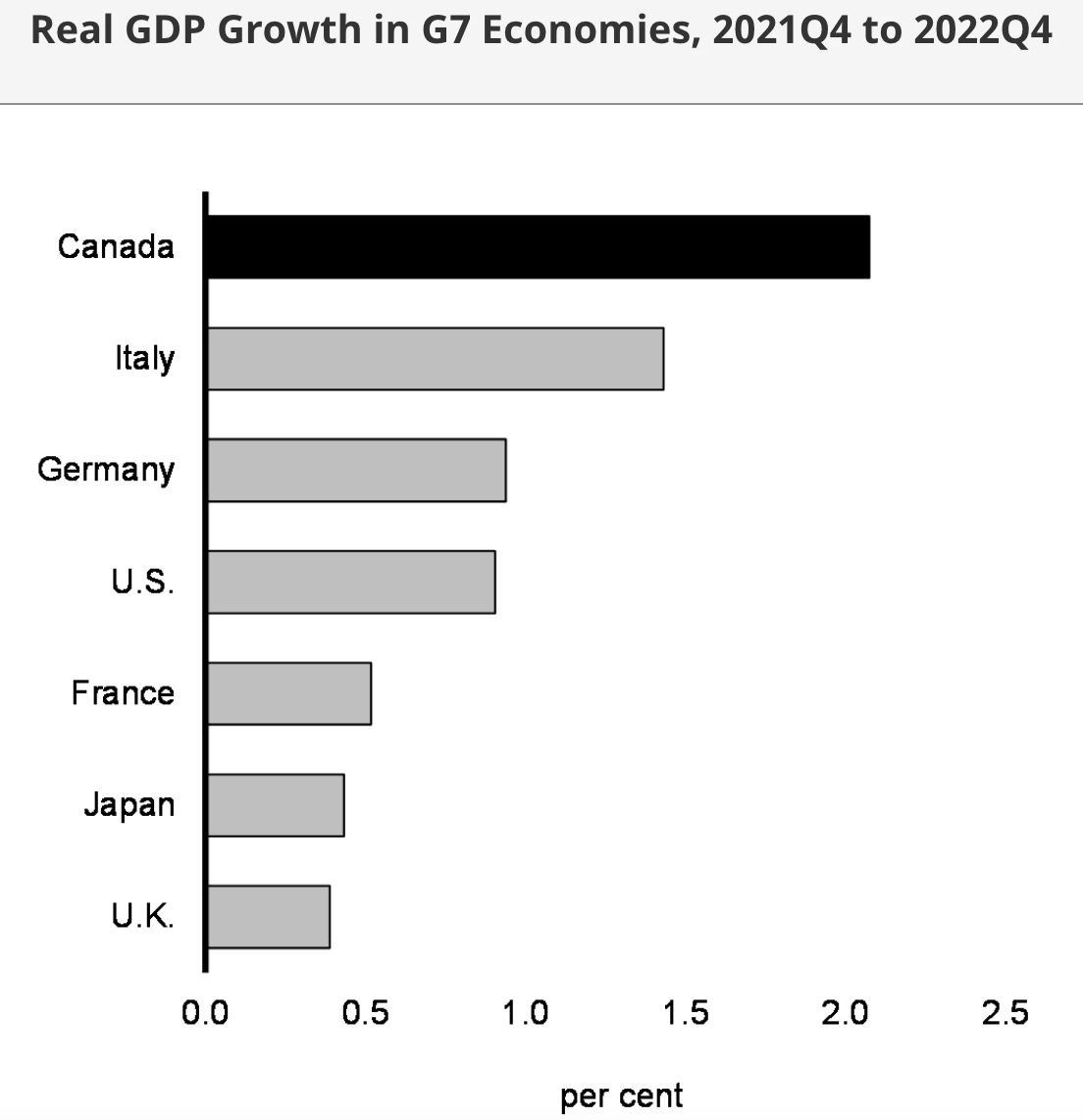
- Our unemployment rate is near its record low – 830,000 more Canadians are employed compared to when COVID-19 first hit, and Canada’s economic growth was the strongest in the G7 over the last year.
- Canada’s economy is now 103 per cent the size it was before the pandemic, marking the fastest recovery of the last four recessions, and the second strongest recovery in the G7.
At the same time, many Canadians are faced with real affordability challenges, and are feeling the effects of higher grocery prices and housing costs. While inflation has fallen in Canada for eight straight months, it remains elevated—both in Canada and around the world.
The result of Canada’s strong economic recovery is labour shortages, and their side effects are still one of the biggest headaches for small businesses. Overall, long term optimism is improving in most sectors.
- Canada’s Small Business Optimism Index has now been on the rise for seven months in a row and is at the highest level in almost a year.
- CFIB’s Business Barometer® long-term index, which is based on 12-month forward expectations for business performance iInched forward at 56.4—about 5 points below the historical average.
- The short-term optimism index, based on a 3-month outlook remained unchanged at 53.5—about 2 points below the historical average.
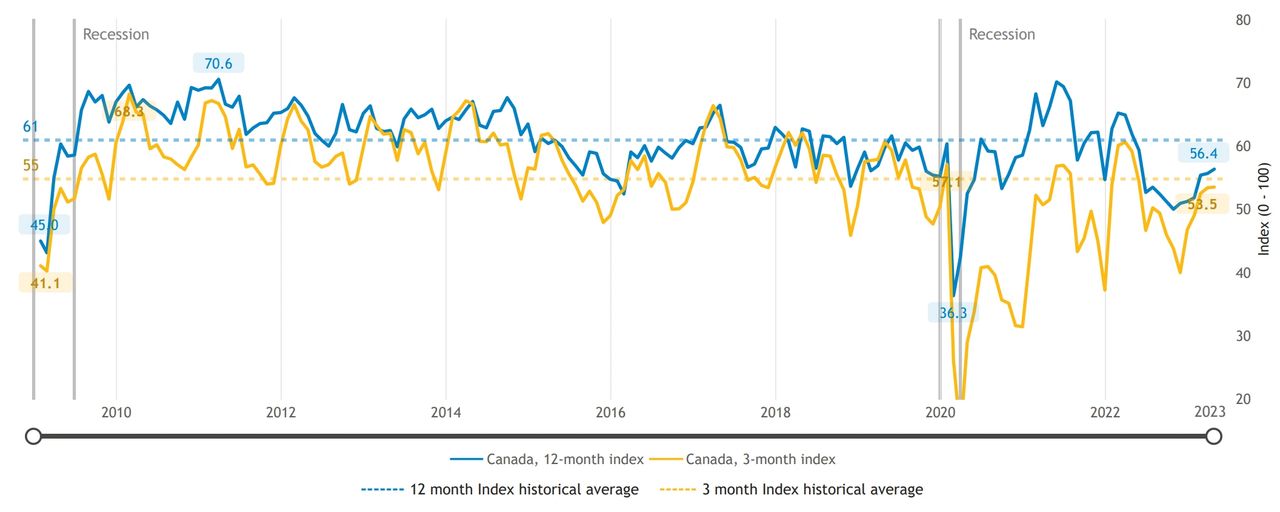
Measured on a scale between 0 and 100, an index above 50 means owners expecting their business’s performance to be stronger over the next three or 12 months outnumber those expecting weaker performance. An index level near 65 normally indicates that the economy is growing at its potential.
All but two provinces report optimism levels above mid-50
- Saskatchewan and Quebec are the only ones just below the 50 mark
- PEI and NL are leading in optimism over the long term with significant improvements from the previous month, and even above their historical averages for this time of the year
- Saskatchewan is the only province that had a notable drop in optimism reaching 51.9.
Overall, long term optimism is improving in most sectors. While some sectors have seen small improvements in optimism, a few have registered decreases in business confidence, most notably transportation and natural resources sectors.
All but three industries report confidence levels above 50:
- Transportation
- Finance, insurance, real estate, and leasing
- Agriculture (for agriculture businesses, this is the 12th consecutive month of very low readings of optimism.)
Canada’s Economic Growth
For many advanced economies, interest rates have risen to their highest levels in more than 15 years. This is resulting in slowing economic growth, both in Canada and around the world.
The rapid rise in interest rates has also led to turmoil in some parts of the global banking system and volatility in global financial markets, highlighting the considerable uncertainty about how economic conditions will evolve going forward.
Canada’s government believes it is well positioned to navigate these turbulent times. Our economy entered 2023 on a better footing than most of our peers:
- Canada’s economy is now 103 per cent the size it was before the pandemic, marking the fastest recovery of the last four recessions, and the second strongest recovery in the G7.
- Throughout 2022, our economy demonstrated sustained strength, with Canada posting the fastest growth in the G7 over the past year.
Real GDP Growth in G7 Economies, 2021Q4 to 2022Q4
- Canada’s strong recovery has supported the strongest labour market in several decades.
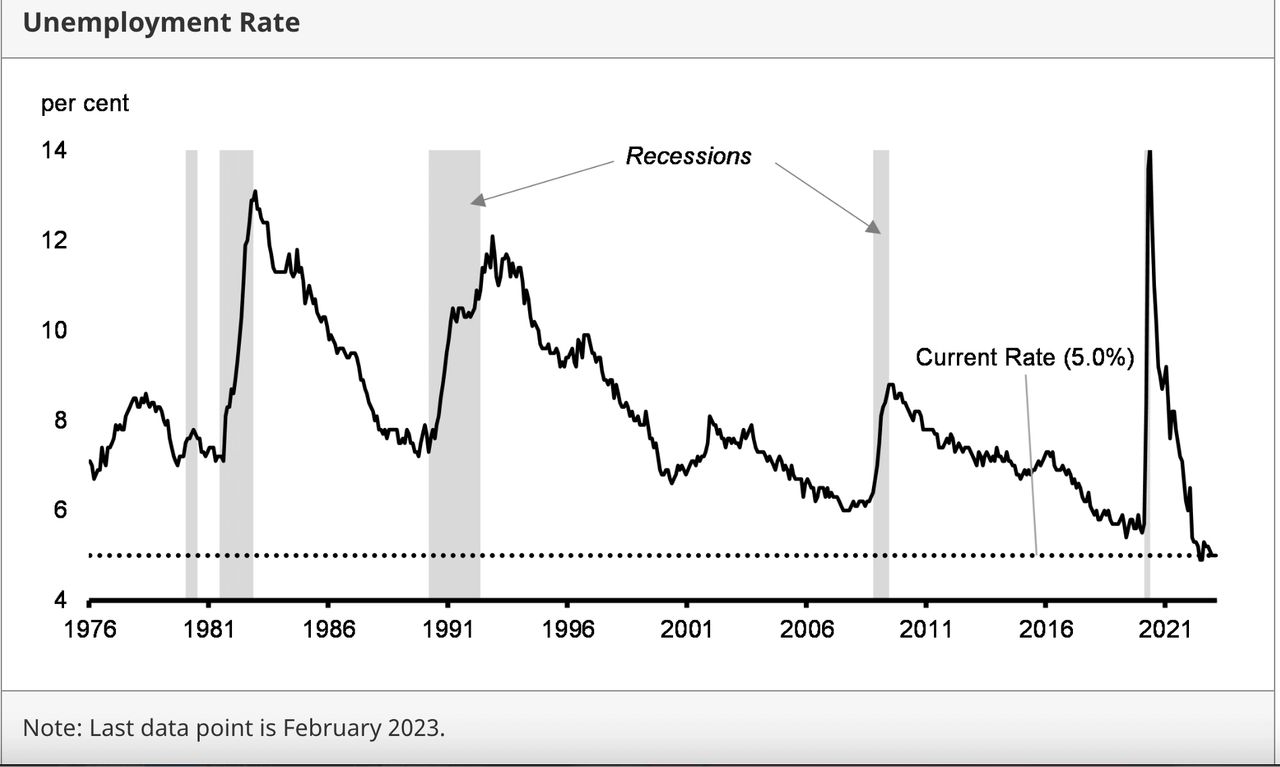
- About 830,000 more Canadians are employed compared to the pre-pandemic period, and at just 5 per cent, the unemployment rate is near its record low of 4.9 per cent.
Unemployment Rate
Making full use of the skills and talents of Canadians is a key driver of a stronger economy, helps to address labour market shortages, and increases the rate at which the economy can grow without generating inflationary pressures.
Canada’s job gains compared to when COVID-19 first hit have outperformed almost all of our G7 peers, supported by a rapidly expanding workforce.
- Notably, the government’s historic investment in early learning and child care is helping more women fully participate in the workforce.
- The labour force participation rate for women aged 25 to 54 years has reached a record high of nearly 86 per cent, compared to just 77 per cent in the U.S.
- At the same time, a record high of 80 per cent of Canadians aged 15 to 64 years are now participating in the workforce, reflecting broad-based gains in employment opportunities across demographic groups.
Immigration – a significant driver of economic growth
- Canada continues to post the fastest population growth in the G7, with strong immigration levels pushing population growth to its fastest pace since the 1950s.
Together, higher immigration and higher labour force participation are expanding the pool of available workers, and offsetting population aging more than in other G7 economies. The resulting boost to employment has helped maintain real household disposable income per capita, even as it declined in peer economies. This is expected to continue to support the Canadian economy throughout 2023. Canada’s immigration system will continue to play an important role in helping our businesses grow.
Canadian Labour Shortages
The result of Canada’s strong economic recovery is labour shortages, as evidenced by the country’s near record-low unemployment rate combined with many unfilled job openings.
Typically, an economic downturn is accompanied by a rise in the unemployment rate.
- Layoffs surge while businesses lower their production.
- But given the current labour shortages, these cutbacks have translated into fewer hours worked and slower hiring.
Labour shortages and their side effects are still one of the biggest headaches for small businesses.
- Many businesses continue to face difficulties hiring workers, with the number of vacant job positions for every unemployed person currently about 75 per cent above the pre-pandemic norm.
- Full-time staffing plans are moderate for this time of the year with only 22% of SMEs planning to hire while 12% are planning to lay off
- Average wage increase plans have seen a small decrease to 3.2 from April level of 3.3.
Factors limiting sales or production growth – current levels and trend, May 2023
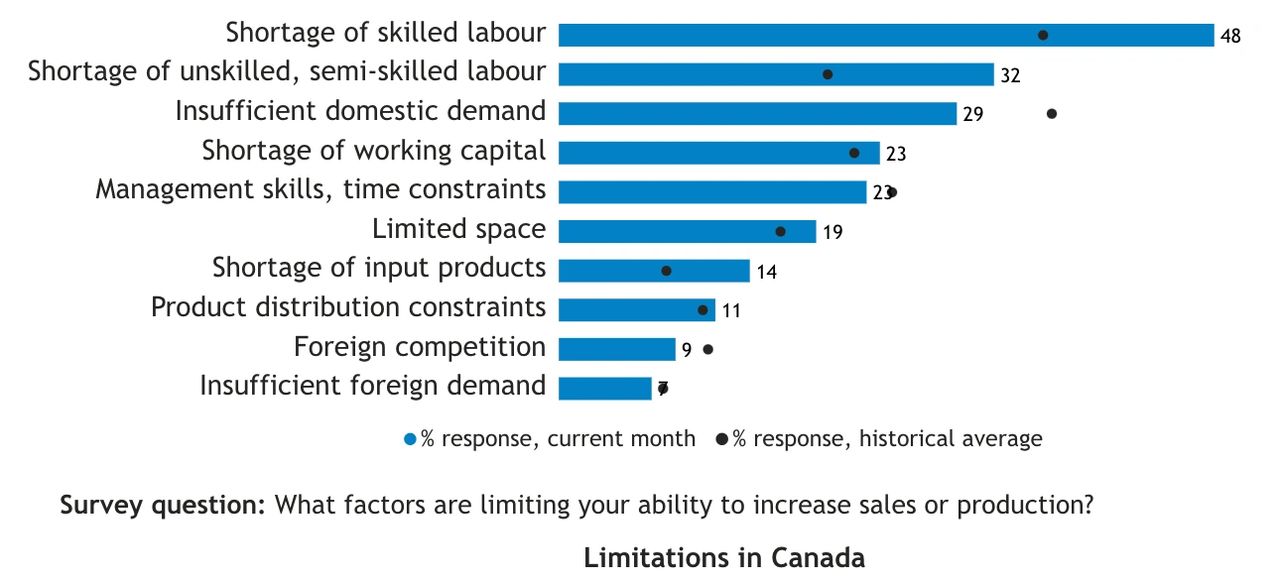
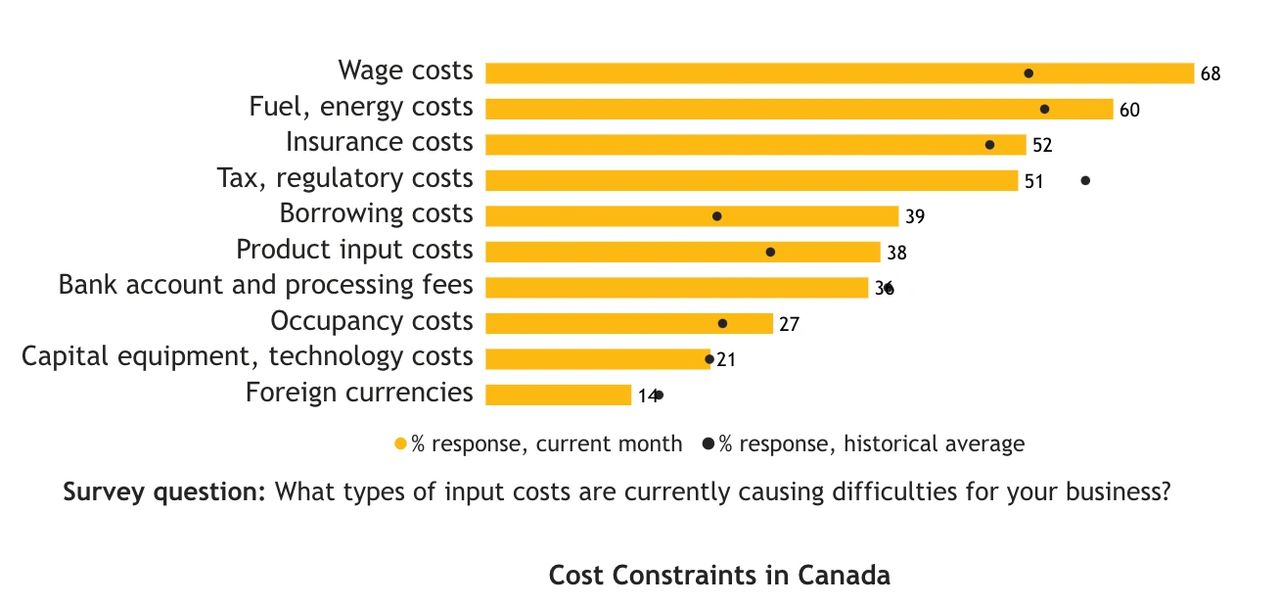
Major input cost constraints – current levels and trend, May 2023
The mismatch in skills between the available workforce and the needs of businesses does not mean that there won’t be any layoffs or that labour shortages will disappear in 2023. The impact of the downturn on the job market will simply be less pronounced than during similar periods in the past, with a gradual return to a balanced job market.
Our unemployment rate is near its record low – 830,000 more Canadians are employed compared to when COVID-19 first hit, and Canada’s economic growth was the strongest i n the G7 over the last year.
Is Your Business Outlook Not-So-Bright?
If you’re needing make some serious changes within your business, find ways to increase your profit, or get Government or Bank funding to expand or pivot, let’s talk. We may be able to help point you in the right direction.
